


Jan 12, 2024 / Uncategorized
When you urgently need a replacement fridge, medical procedure, or car repair, paying the full amount upfront might not be in the cards. We all know real life isn’t always pay-in-full friendly. That’s why credit exists — to bridge the gap between life happening and your paycheck catching up without exhausting your savings.
Over time, though, your debt can become scattered across loans, medical bills, and credit cards you forgot you even had. If it is, you’ve probably got multiple balances, mismatched due dates, and interest rates eating away at your spending power. But take a deep breath — because it’s totally fixable!
Debt consolidation is how you take back control. It’s the process of combining multiple debts into one cleaner, more affordable payment that helps you stretch your budget farther and get out of debt with less stress. Let’s talk about how to consolidate debt in the best way for your situation — and why Utah First is the right partner in crime to help you do it!
At a high level, debt consolidation takes a bunch of separate balances and pulls them into a single, more doable credit setup. Instead of having to track interest rates and payment dates like side quests, you swap them for one manageable (often lower) monthly payment.
People usually consolidate when they:
There’s no one “right” way to consolidate, which is actually good news. Depending on your goals, credit profile, and what kind of debt you’re working with, you’ve got options:
A quick clarification: Consolidation isn’t the same as refinancing. Consolidation simplifies multiple debts into one, while refinancing replaces existing loan terms with more favorable ones. Similar approach, different goal.
Before choosing a consolidation option, it helps to know which kind of credit you’re dealing with.
Revolving credit means you can use the credit, pay on it, and keep borrowing. Credit cards and HELOCs work this way.
The upsides:
The tradeoff:
If you’re not careful, it’s easy to pay things off and then slowly rebuild the balance. Revolving credit works best if you want flexibility and trust yourself not to re-spend.
Non-revolving credit is one-and-done. You borrow a set amount, make fixed payments on a schedule, and when it’s paid off, you’re finished. Personal loans and home equity loans work this way.
The upsides:
The tradeoff:
Non-revolving loans work best if structure keeps you focused and guardrails help you avoid rebuilding debt.
If flexibility is important to you, revolving credit can work. If guardrails are more helpful, non-revolving loans usually win.
Let’s look at each of these consolidation options a little closer.
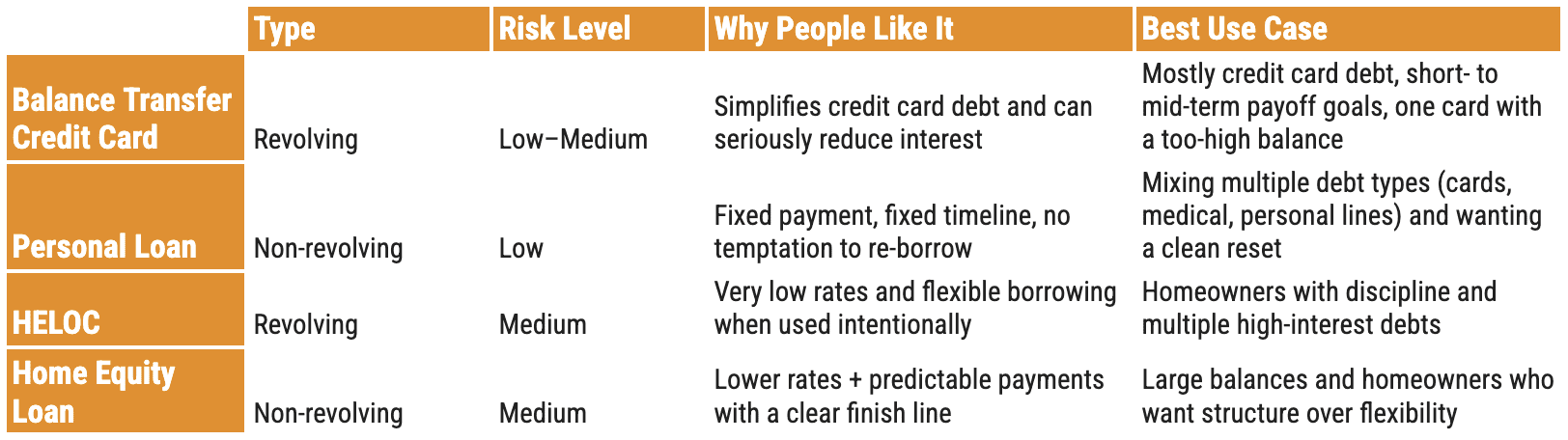
If most of your debt is on credit cards, a balance transfer is often the fastest way to clean up your money life.
A credit card balance transfer moves one or more high-interest card balances to a new card with a lower interest rate — like the 9.0% fixed-rate Utah First Orange Platinum Visa. In the end, you’re left with one consolidated balance and a single monthly payment instead of juggling multiple.
Lower interest means knocking out more of your principal balance instead of losing money to interest. It’s one of the fastest ways to tame high-interest credit card debt and simplify your monthly routine.
Balance transfers usually require good credit, and on many cards, the “low/0% intro APR” comes with a ticking clock. Once that promo ends, rates jump, and the math gets way less fun.
That’s where Orange Platinum is different. There’s no balance transfer fee, and the promo APR is locked in for the life of the transferred balance, not just a few months.
Balance transfers are great for those who:
If you’re craving structure, predictability, and a clear finish line, a personal loan is a great way to get it done.
A personal loan for debt consolidation is a fixed-rate, fixed-term loan that lets you pay off multiple debts at once. After that, you’re left with one predictable payment and an end in sight without having to re-borrow.
With personal loans, payments stay the same every month, rates are often lower than credit cards, and because the loan isn’t revolving, you can’t re-spend the balance. This makes them great for breaking overspending habits and closing your debt chapter.
Rates vary by credit score, and some loans involve origination fees. Many people still find the predictability worth it, though!
Personal loan consolidation is perfect if you’re consolidating multiple types of debt — credit cards, medical bills, personal lines — and want a straightforward plan with a set end date.
If you’ve built equity and want lower rates with flexibility, a HELOC deserves a closer look.
A HELOC is a revolving line of credit backed by your home equity. It works kind of like a credit card with a lower APR. You borrow what you need, as you need it, paying interest only on what you use — making it a solid option for consolidating multiple high-interest debts.
HELOCs have two phases that affect how you borrow:
It’s a built-in shift from flexible to focused to keep your consolidation plan on track!
Utah First’s HELOC comes with up to five rate locks, which means you can lock portions of your balance into fixed rates for extra flexibility and predictability. With us as your financial partner, the wins just keep stacking!
HELOCs usually come with way lower APRs than credit cards or personal lines of credit (5.15% with us, to be exact!). The flexibility is another huge plus, since you’re not forced to borrow more than you need and can tailor how you use it. Add in Utah First’s rate locks, and you get control without giving up options!
HELOCs often have variable rates (unless you lock in portions of your balance with Utah First), so your monthly repayment amount might change over time. Your home is also collateral, so this option should be used cautiously. And since a HELOC is a type of revolving credit, it’s important not to rebuild debt by treating it like a shopping card.
A HELOC reconsolidation is best for homeowners with strong spending habits and multiple high-interest balances. If you want flexibility, lower rates, and the ability to customize how you pay things down, a HELOC is a fantastic way to flex on your debt.
If you like knowing exactly what’s coming and when you’ll be done, a home equity loan gets you.
A home equity loan lets you leverage the value in your home to consolidate debt. With a fixed interest rate, you get a lump sum to settle debts and enjoy the ease of a consistent monthly payment as you repay the loan over time.
Home equity loans are secured by your house, so interest rates tend to be lower than options like unsecured credit cards or personal loans. And since the rate and payment are fixed, budgeting is straightforward, and you enjoy a predictable payoff. It’s simple, steady, and super easy to stick with!
Home equity loans can come with closing costs, so there’s a little upfront planning involved. And with your home serving as collateral, this option should be considered carefully.
Home equity loans are best for homeowners consolidating larger balances who want structure, predictability, and a straightforward payoff plan. If flexibility stresses you out and consistency keeps you on track, this option makes a lot of sense.
Not every debt solution floating around out there is helpful for where you’re at. Some sound amazing on the surface but can cause more problems later. This doesn’t mean they’re bad options; they’re just made for specific scenarios and aren’t where most people should start.
As a rule of thumb, if something promises fast relief, zero effort, or feels a little too magical, it’s worth a pause. The best debt consolidation moves are the ones you can live with long-term. Here are some options to be careful about.
Cash-out refinancing can make sense in the right scenario, but it’s not a consolidation fix for everyone and isn’t intended as a quick cleanup move. When you roll debt into a new mortgage, you’re usually spreading it out over decades, paying more interest overall, and resetting your home loan timeline.
If rates are right and it fits your long-term plan, sweet! But if the goal is just to tidy things up fast, this usually isn’t the move.
Debt settlement is very much a “break-glass-in-case-of-emergency” option. Most debt settlement programs involve purposely missing payments, which can wreck your credit and pile on fees with no guarantee that it’ll actually fix everything.
When you’re already stressed, this approach won’t usually provide much relief. Last-resort energy only!
Be cautious here. Many for-profit companies charge high fees to do things you can often do yourself or through a nonprofit debt management plan (DMP). Nonprofit DMPs can be helpful in certain cases, but if someone promises to “fix everything fast” for a price, that’s your cue to slow down and ask questions.
Borrowing from your retirement can be easy and convenient, but this move comes with long-term consequences. You’re pulling money from your future self, missing out on potential growth, and risking penalties if job circumstances change. In rare cases, it may make sense, but it’s almost never the first option to explore.
Before you lock anything in, know that choosing a consolidation method is about picking the option that works for your life without creating new stress later.
Below are some factors worth paying attention to!
Annual percentage rate (APR) is basically the price tag on your consolidation loan. Lower APR means more of your payment is applied to what you owe instead of feeding interest.
Just don’t get distracted by shiny promo rates alone. Some are temporary, some are locked in — so be sure you know what your rate looks like long-term to avoid getting caught off guard later!
The length of your consolidation loan also matters. The smaller monthly payments that come with longer terms can feel like instant relief, but the catch is that you’ll pay more interest in the long haul. Shorter terms cost more per month but get you out of debt faster and more cost-effectively overall.
The goal is to find a term that fits your budget without making your loan a long-term commitment.
When it comes to debt consolidation, the best payment is one you can make consistently without white-knuckling your budget. Bigger payments can speed things up, but only if they don’t make the rest of your finances miserable.
If a payment feels tight now, it’s going to feel worse later. Choose a term that gives you doable payments in support of your progress and peace of mind.
The size of your balance can help you decide which consolidation method is right for you. Smaller balances often pair well with credit card balance transfers or personal loans, while bigger balances usually need lower rates and longer timelines with options like home equity loans.
Always look at the total cost of a debt consolidation, not just the rate. Transfer fees, origination fees, and closing costs all count. Sometimes the option with fewer fees actually saves you more, even if the APR is slightly higher! And remember: no balance transfer fees on Orange Platinum! We’re just saying…
Consolidation options affect your credit in different ways, which is worth keeping in mind as you choose a path. Most consolidation options involve a hard inquiry, which can cause your credit score to dip a little temporarily. If you’re planning a big credit move soon (like buying a home or car), options with fewer inquiries or slower timelines may make more sense.
Credit utilization is where consolidation can really work in your favor. Paying down high credit card balances — especially through balance transfers, personal loans, or home equity options — can lower utilization and often help your score over time. If cards are your main issue, methods that pay them off completely tend to be the biggest win.
Then there’s the question of closing accounts vs. keeping them open. If you consolidate with a personal or home equity loan, your cards stay open, which can help with utilization if you don’t reuse them. If temptation is a concern, choosing a non-revolving option (like a personal loan or home equity loan) can protect your progress.
Debt consolidation can be a total power move if you don’t accidentally undo it. Here are a few missteps to avoid so you can make sure your financial reset sticks:
Consolidation isn’t a free pass to keep swiping to your heart’s content (especially with revolving credit). It works best when you pair it with a quick reality check on spending, so new debt doesn’t sneak back in behind you.
Smaller monthly payments can feel like a win, and they can be! But stretching things out too long means paying more interest over time. Find a payment plan that fits your life while keeping you moving forward rather than running in place.
If someone guarantees to wipe out your debt overnight, run. Fast. These programs can wreck your credit and cost more in the long run. True progress is boring, steady, and much more effective.
HELOCs are powerful tools, but they’re not for casual re-spending. Treating one like a revolving credit line without specific goals can rebuild debt as quickly as you paid it off. Use it intentionally, lock rates when you can, and stay in control!
When you’re ready to simplify your financial life, Utah First has your back. We know debt consolidation looks different for everyone, which is why we give you judgment-free choices instead of one default solution.
We can help with:
At Utah First, we create loans for all credit types. We’re genuinely obsessed with saying yes — especially to people who’ve been told no somewhere else. If we believe you can repay a loan, we want to help you get approved. It’s our way of putting people over profits and meeting you right where you are!
And along the way, you’ll have:
However you decide to move forward, we’re here to help you do it like a pro.
You don’t need to be perfect with money to reduce debt stress. You just need to find the right fix so you can start making maintainable progress! The smartest consolidation plan is the one that fits your habits, goals, and life.
When done right, debt consolidation simplifies your payments, reduces strain, and gives you a simple path forward without shaming you for how you got there.
If you’re ready to clean things up, Utah First is here to help you find the best tools. Reach out to a financial expert today to chat through your options!